
Sorry is the hardest word

Last weekend I went to a wonderful workshop on ‘Creativity and Shadow’ run by my friend, the sculptor Vivien Whitaker, at Woodbrooke in Birmingham. A small group of women, based in the Art Room away from the main conference centre, worked on the subject using our hands and hearts and for all of us it was an intense experience. As some of us said afterwards, questions like ‘Did you enjoy it?’ and ‘Did you have a good time?’ were not really relevant!

In order to approach and understand our shadow-side we looked at our strengths and how these might tip over into ‘over-strengths’. For me this involved taking responsibility. I know that I can do this but I also know that I have reached the stage of over-strength, when I try to take responsibility for everything and cannot let go and allow other people (and especially my family) to take responsibility themselves. All my children are grown-up people but I am having problems letting go of my ‘mother’ role, especially the mother who tries to make everything all right.

For me this is encapsulated in the word ‘sorry’. Whenever anything goes wrong I say sorry. Sometimes I just mean that I am sorry a bad thing has happened but that is not how my family hear it. They hear me taking everything on myself – again! My elder son got very annoyed with me over the phone a couple of weeks ago when I was saying sorry for his car failing its MOT. ‘It’s not your fault. It’s nothing to do with you, it’s my problem.’ he said. ‘I wish I could take the word Sorry out of the dictionary!’


So it is not surprising that when Vivien gave each of us a plain white paper fan and asked us to depict our shadow on one side and our dream of the future on the other I immediately started on the shadow side and produced this. I wrote the word Sorry everywhere I could and outlined the whole thing in black, like a Victorian mourning letter

I wanted to acknowledge this shadow side of myself, partly so I could try to change it but also because I really am sorry for a lot of my failings and weaknesses. I am also still carrying around a lot of guilt for things done, undone or not done well enough in the past which will take time to work through.

The shadow is part of me and my task is to integrate it so that it becomes part of my wholeness instead of threatening to overwhelm me with depression and feelings of worthlessness. The weekend helped me to realise the effect that my shadow has had and is sometimes still having on my family and I am really putting some effort into working on that. I have displayed the shadow side of my fan in my study where it can act as a constant reminder and I am trying to remove that word from my personal dictionary

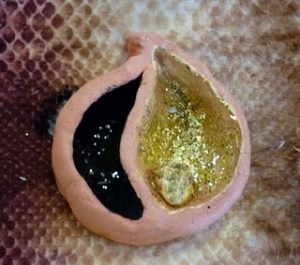
The last piece we made at the weekend was an expression of our hope for the future. I made a shape in clay based on a seedcase I had picked up in Kew Gardens with two halves, one open and gold and one closed in and black, although with a few bits of glitter even there. The ‘seed’, made with a shell, combined both colours, dark and light. I placed it on a piece of printed velvet and wrapped the whole thing in card and tissue paper, black and dull on the outside, gold and shiny within, all tied together with a multicoloured thread.

The whole group explained their pieces to the others and as I did this I unwrapped the parcel. When I got home I took all the outer casings off and put the clay on a low shelf where I can see it every day
The song says that ‘Sorry is the hardest word to say’. For me it is the hardest word to stop saying but I am resolved to try. One way in which I am going to do this is not to say sorry when I don’t write this blog. I am going to stop imposing ‘once a week’ or ‘once a month’ rules on myself which set me up to fail. I will write when I have something to say and I will not apologise for that.

The Ministry-Life Balancing Act

Reading Robin’s post the other day got me thinking about the struggles I have had with recognising and finding ways to follow my own ministry.

It took me a long time to feel that my interest in spiritual autobiography could be seen as a kind of ministry. It was only when I moved from an academic and personal view of the subject to the development of a workshop that aimed to tell others about the form and tradition of this kind of writing and to encourage them to attempt to write their own that the thought that what I was doing was ministry entered my head.

I was ‘released’ to follow this ministry more intensively by a combination of the Joseph Rowntree Charitable Trust awarding me a fellowship and my employer promising that I would have a job to return to after a year. At the time, having gone through the experience of being made redundant twice, I would not have been brave enough to proceed without that safety net.

Afterwards I went back to work but also continued giving workshops and wrote an account of the fellowship. This brought me into writing and publishing both of which I now see as part of the same ministry. I know that I have been led along the path I have taken and sometimes I have been gently but firmly pushed into taking the next step. Looking back I realise that it is always when I have turned outwards, shared my experience and the experience and words of Quaker foremothers and forefathers with others, that what I have done has become ministry.

Along the way I have sometimes taken false steps. There was a time when I really wanted to find a job in the Quaker world. I thought that this would free me from having to balance my Quaker calling with other paid work. Failure and rejection were hard lessons but in time I learned from them. I remained independent and gained much from the work that did come my way. All the time I know that my Inward Teacher has been providing me with lessons that I needed to learn and has been patient with my slowness to understand.

Many years ago in meeting I was given three phrases which I understood were messages for me and not to be shared at that time. I wrote them down and they have travelled with me as lessons and encouragement in my ministry and my life. They are – ‘Count your blessings’ , ‘A way will open’ and ‘My time is not your time’.

I understand more about what my ministry is and how I should express it as time goes on. Now that I have retired from paid work my view of it is slowly changing again. I am trying to be open to new possibilities but I am also continuing to write and publish, if only infrequently, here and elsewhere. God knows where I will be led next but I am still waiting to find out.

Failing to turn inside out?

Once upon a time, well in 1994 actually, I set out on a journey round Britain Yearly Meeting as a Joseph Rowntree Fellow with a project called ‘What canst thou say?’ I was trying to reintroduce Friends and others to the tradition of spiritual autobiography, not just as an historical exercise but as a way of sharing our different spiritual journeys with one another.

Eventually I wrote a book about the fellowship called Turning inside out, a title that expressed what for me seemed the most important part of the exercise. I was trying to encourage Friends to look inside themselves and think about their spiritual journey, then to write about it and eventually to turn the inside out and share that spiritual autobiography with others in whatever way and at whatever time seemed right for them. I also stressed that it was equally important to listen to others’ stories even if they were very different from our own.

When I started out I was reacting to what I saw as a sense of isolation among British Friends and a lack of opportunity to share our spiritual journeys with one another. More than one person told me that the only time they were given such an opportunity was when they were visited after they applied for membership!

I continued giving the workshops for nearly ten years after the fellowship ended but although what I had to say was generally well received I ended with a sense of failure. It seemed to me that people were happy with the first steps, looking at their spiritual autobiography and even writing it for themselves, but that turning inside out and sharing it with others, as well as listening to others’ different experience was much more difficult.

Certainly over the years the practice of spiritual autobiography has become much more widespread, particularly in America and through blogging, but I still feel that there is a problem with British Friends. Perhaps we really are more reserved and uncomfortable with personal disclosure. Perhaps it is tied up with our increasing individualism and the idea that anything goes. If we are not looking for a way to draw together and discern a way forward as a group, if we are only looking for other like-minded people to feel comfortable with, then we do not have to acknowledge our differences and can dismiss the ‘other’.

When I came across the convergent conversation in the blogosphere I felt an excitement and hope that I had not felt for some time. I thought that what I had tried to do before had failed but that now perhaps what I need to do is to ask the questions of British Friends again, to encourage them to make connections in love with the ‘difficult’ people and beliefs in their own yearly meeting and in the rest of the Quaker world.