Hello world!

Welcome to WordPress.com. After you read this, you should delete and write your own post, with a new title above. Or hit Add New on the left (of the admin dashboard) to start a fresh post.

Here are some suggestions for your first post.

  1. You can find new ideas for what to blog about by reading the Daily Post.
  2. Add PressThis to your browser. It creates a new blog post for you about any interesting  page you read on the web.
  3. Make some changes to this page, and then hit preview on the right. You can alway preview any post or edit you before you share it to the world.

Art and Nature

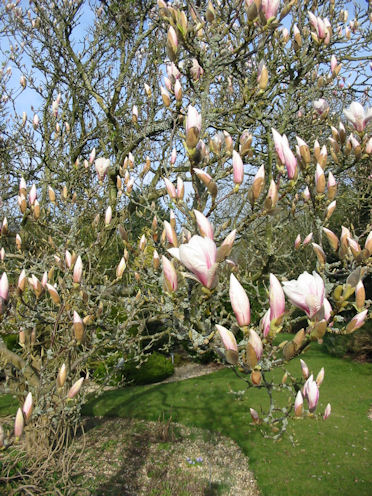
Spring is here and the magnolias are coming into bud, just waiting to burst into flower. I love the shape of the buds in this stage and have taken plenty of photographs of them, like this one of the Hillier garden near Lymington.

Looking at them again today though I was reminded, as I always am, not of the last time I looked at the real thing, nor of a photograph, but of a painting. This particular painting hung on a classroom wall in my secondary school, so I must have first encountered it when I was ten or eleven years old. It was of a magnolia tree full of pink flowers, mainly in bud but with some coming into full bloom. The bare branches and upright flowers were set against a perfectly blue sky. There may have been a wall in the background but it is the contrast between blue and pink that I remember. Sadly I do not remember the artist and have scoured Google Images in vain!


This is one of the books I treasured


Looking at pictures has always been important to me, beginning with illustrations in books. My memory of those illustrations is more than visual, sometimes I can almost taste them, as if the child that I was used all her senses to register and remember those images. I remember nothing of the words of the various Flower Fairies books by Cicely Mary Barker but I vividly remember the illustrations.

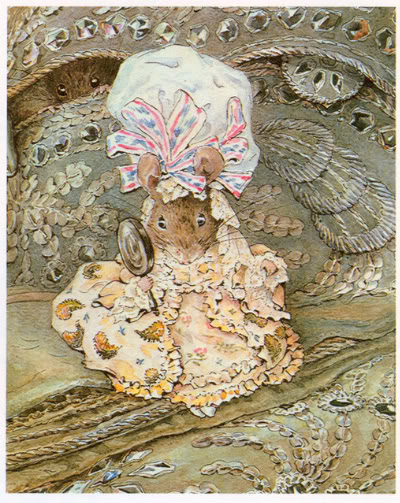
I also loved the detail of Beatrix Potter’s illustrations especially all the clothes in the Tailor of Gloucester.

I was particularly fond too of Margaret Tempest’s illustrations for Alison Uttley’s series about Little Gray Rabbit and I imagined being inside the house in the wood which appeared on every endpaper, even though it was in black and white.


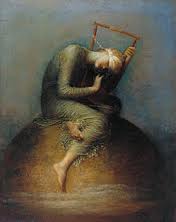
Hope by G.F.Watts


From illustrations in books I graduated to the sheets of art reproductions which were issued as a series by the periodical Child Education and collected by my mother, a primary school teacher. She kept them between cardboard covers under a bed at home and every so often I was allowed to get them out and look through them. This must have been at about the same time as I was looking at the painting of the magnolias at school. The series was full of Victorian classics, many in sepia, but I still remember them with the same intensity as I do the illustrations in books.


 I also remember the thrill, many years later, of visiting the Lady Lever Gallery at Port Sunlight near Liverpool and seeing so many of my favourites on the walls and in full colour! 


Millais – Sir Isumbras at the Ford


For almost all of my life Art and Nature, the one complementing the other, have both fed my spirit with an intensity which roots me in the present while at the same time bringing back memories of the past. Long may they continue to do so!


Let me introduce you to my Friends – Grace Hall Chamber

I have been meaning for a while to begin a series on some of my Quaker Friends from the past who inspire me and I hope will inspire others. On International Women’s Day I thought it appropriate to begin with a woman who, although a minister, did not travel extensively and did not write anything for publication. Most of what we know about her comes from a handful of surviving manuscript letters and from references to her in the writings of many of her contemporaries. To them she was usually known affectionately as ‘dear Grace’.

Grace Hall Chamber was born in 1676 near Durham. She was the only child of James Hall and his second wife, but she also had five siblings, the children of her father and his first wife. Grace was educated at home in a prosperous Quaker family and being ‘endowed with an excellent understanding’ acquired considerable skill in medicine and surgery which she used throughout her life.

In 1704 she married Robert Chamber, a substantial Friend, and moved to his family home at Sedgwick near Kendal. Grace had an extensive acquaintance among all classes of society in her local community and concerned herself with the lives and happiness of all her friends, not only Quakers. In 1711 she was recognised as having a gift of ministry among Friends although she did not speak frequently or at length. Her travel in the ministry was mainly local and in the company of her husband. There is no record that Grace and Robert had any children of their own, but Grace acted as a mother, nurse and friend to all who needed her, often caring for them in her own home.

Grace’s letters give two glimpses of her caring ministry. In 1737 she writes an account for his friends of the death in her house from smallpox of Charles Barnett, a travelling minister far from home. She writes – ‘He had not one minute of perfect ease since he came to us so that we had very little discourse with him upon any account but his illness and what might be of service and most suitable for him, but the first morning after he found he was not able to travel he named his wife, as she little knew how he was and said, “I am out of all their reach. I am two hundred miles from my habitation.” And I answered, “Think thyself at home. We will do whatever we can for thee. Thou shalt want for nothing we either have or can get to do thee good.”‘ The letter continues with a description of the funeral and, on a practical note, an account of the effects of the deceased and of the memoranda Grace had written at his dictation.

In 1743 Grace writes about the care she is giving to Fanny Henshaw who she took into her home for more than a month. Fanny was brought up in the Church of England but became a Quaker as a young woman, much to the dismay of her family and friends. Very soon after her convincement – perhaps too soon – she began to travel in the ministry and became exhausted both physically and mentally.

Grace writes of Fanny’s situation – ‘She has been quite overdone, both body and spirits, and the fever coming upon her in that low condition was beyond what her constitution could undergo without being borne down below measure, which is not easily recruited, there being need of both inward and outward helps. As divine providence has provided both for our souls and bodies so I conclude we ought to receive both in as much faith and thankfulness as possible we can.’ Grace gave her rest, counsel and the recommended treatment of salt and fresh water baths until she recovered and reflects – ‘May we above all things look to the giver of all our good enjoyments in all our circumstances, whether it being plenty or poverty, he knows best what is good for us and we may soon learn by experience both how to order ourselves and advise others – this is what I am and have often been concerned for in secret.’

In 1753, when they had been married for almost fifty years, Robert Chamber died. Grace characterised Robert as ‘one of the best of husbands’ but acknowledged that her ministry had always to take account of his needs. As she said, ‘He was very unwilling to want me, but I think he made that up, as much as any man in his circumstance could have done, in letting his house be free and open to sick and lame, poor and rich. If I were but there it was mostly well.’

In her widowhood Grace travelled further afield in the ministry, often with her lifelong friend Lydia Lancaster. In 1760 they went on a journey to Bath, Bristol and London. Contemporaries wondered at their taking on so much when so advanced in years but described them both as ‘green in old age’. On her return Grace became more infirm, finding it difficult to get to even local Quaker meetings. She died, aged 85, at Sedgwick and was buried in the Friends burial ground at Preston Patrick.

Poetry for Brigid

I picked this up from one of the blogs I subscribe to and thought it was such a good idea that I’d pass it on. All I have to do now is choose a poem to post, which may not be easy!

Feel free to copy the following to your blog and spread the word. Let poetry bless the blogosphere once again!
WHAT: A Bloggers (Silent) Poetry Reading
WHEN: Anytime February 2, 2009
WHERE: Your blog
WHY: To celebrate the Feast of Brigid, aka Groundhog Day
HOW: Select a poem you like – by a favorite poet or one of your own – to post February 2nd.
RSVP: If you plan to publish, feel free to leave a comment and link on this post. Last year when the call went out there was more poetry in cyberspace than I could keep track of. So, link to whoever you hear about this from and a mighty web of poetry will be spun.Feel free to pass this invitation on to any and all bloggers.

Heather’s reading meme

Heather put this meme on her blog so I am considering myself tagged and putting it on mine. If anyone out there wants to join in they are welcome!

Instructions:
1) Look at the list and bold those you have read.
2) Underline those you intend to read. (I had to make them a different colour instead – no underline on Blogger!!)
3) Italicise the books you LOVE.
4) Post your list so we can try and track down these people who’ve only read 6 and force books upon them.(I’ve also marked with an S the books I started and couldn’t finish….)

1. Pride and Prejudice – Jane Austen
2. The Lord of the Rings – JRR Tolkien
3. Jane Eyre – Charlotte Bronte
4. Harry Potter series – JK Rowling
5. To Kill a Mockingbird – Harper Lee
6. The Bible
7. Wuthering Heights – Emily Bronte
8. Nineteen Eighty Four – George Orwell
9. His Dark Materials – Philip Pullman
10. Great Expectations – Charles Dickens
11. Little Women – Louisa M Alcott
12. Tess of the D’Urbervilles – Thomas Hardy
13. Catch 22 – Joseph Heller
14. Complete Works of Shakespeare
15. Rebecca – Daphne Du Maurier
16. The Hobbit – JRR Tolkien
17. Birdsong – Sebastian Faulks
18. Catcher in the Rye – J D Salinger
19. The Time Traveller’s Wife – Audrey Niffenegger
20. Middlemarch – George Eliot
21. Gone With The Wind – Margaret Mitchell
22. The Great Gatsby – F Scott Fitzgerald
23. Bleak House – Charles Dickens S
24. War and Peace – Leo Tolstoy S
25. The Hitch Hiker’s Guide to the Galaxy – Douglas Adams
26. Brideshead Revisited – Evelyn Waugh
27. Crime and Punishment – Fyodor Dostoyevsky
28. Grapes of Wrath – John Steinbeck
29. Alice in Wonderland – Lewis Carroll
30. The Wind in the Willows – Kenneth Grahame
31. Anna Karenina – Leo Tolstoy
32. David Copperfield – Charles Dickens
33. Chronicles of Narnia – CS Lewis
34. Emma – Jane Austen
35. Persuasion – Jane Austen
36. The Lion, The Witch and The Wardrobe – CS Lewis
37. The Kite Runner – Khaled Hosseini
38. Captain Corelli’s Mandolin – Louis De Bernieres
39. Memoirs of a Geisha – Arthur Golden
40. Winnie the Pooh – AA Milne
41. Animal Farm – George Orwell
42. The Da Vinci Code – Dan Brown
43. One Hundred Years of Solitude – Gabriel Garcia Marquez
44. A Prayer for Owen Meaney – John Irving
45. The Woman in White – Wilkie Collins
46. Anne of Green Gables – LM Montgomery
47. Far From The Madding Crowd – Thomas Hardy
48. The Handmaid’s Tale – Margaret Atwood
49. Lord of the Flies – William Golding
50. Atonement – Ian McEwan
51. Life of Pi – Yann Martel
52. Dune – Frank Herbert
53. Cold Comfort Farm – Stella Gibbons
54. Sense and Sensibility – Jane Austen
55. A Suitable Boy – Vikram Seth
56. The Shadow of the Wind – Carlos Ruiz Zafon
57. A Tale Of Two Cities – Charles Dickens
58. Brave New World – Aldous Huxley
59. The Curious Incident of the Dog in the Night-time – Mark Haddon
60. Love In The Time Of Cholera – Gabriel Garcia Marquez
61. Of Mice and Men – John Steinbeck
62. Lolita – Vladimir Nabokov
63. The Secret History – Donna Tartt
64. The Lovely Bones – Alice Sebold
65. Count of Monte Cristo – Alexandre Dumas
66. On The Road – Jack Kerouac
67. Jude the Obscure – Thomas Hardy
68. Bridget Jones’ Diary – Helen Fielding
69. Midnight’s Children – Salman Rushdie
70. Moby Dick – Herman Melville
71. Oliver Twist – Charles Dickens
72. Dracula – Bram Stoker
73. The Secret Garden – Frances Hodgson Burnett
74. Notes From A Small Island – Bill Bryson
75. Ulysses – James Joyce
76. The Bell Jar – Sylvia Plath
77. Swallows and Amazons – Arthur Ransome
78. Germinal – Emile Zola
79. Vanity Fair – William Makepeace Thackeray
80. Possession – AS Byatt
81. A Christmas Carol – Charles Dickens
82. Cloud Atlas – David Mitchell
83. The Color Purple – Alice Walker
84. The Remains of the Day – Kazuo Ishiguro
85. Madame Bovary – Gustave Flaubert
86. A Fine Balance – Rohinton Mistry
87. Charlotte’s Web – EB White
88. The Five People You Meet In Heaven – Mitch Albom
89. Adventures of Sherlock Holmes – Sir Arthur Conan Doyle
90. The Faraway Tree Collection – Enid Blyton
91. Heart of Darkness – Joseph Conrad
92. The Little Prince – Antoine De Saint-Exupery
93. The Wasp Factory – Iain Banks
94. Watership Down – Richard Adams
95. A Confederacy of Dunces – John Kennedy Toole
96. A Town Like Alice – Nevil Shute
97. The Three Musketeers – Alexandre Dumas
98. Hamlet – William Shakespeare
99. Charlie and the Chocolate Factory – Roald Dahl
100. Les Miserables – Victor Hugo

A leap of faith

I am a naturally anxious and fearful person and, as my children say, I can worry for England. I have been thinking about the courage that I need to follow my leadings and how I have often gained strength from reading about the experience of others. While still at school the first spiritual autobiography I ever read was John Bunyan’s Grace Abounding to the Chief of Sinners and I was much struck by it. One passage in particular spoke to me then and has continued to be an inspiration even if I don’t always manage to act on it.

Bunyan was also a fearful person, continually anxious that God might forsake him. Imprisoned for preaching his faith he thought that he might be hanged and imagined himself on the gallows, standing ‘on the ladder, with the Rope about my neck’. He asked God for comfort but none came. Then Bunyan realised that he had to trust in the love of God without asking for any assurance in return –
‘Wherefore thought I, the point being thus, I am for going on, and venturing my eternal state with Christ, whether I have comfort here or no; if God doth not come in, thought I, I will leap off the Ladder even blindfold into Eternitie, sink or swim, come heaven, come hell; Lord Jesus, if thou wilt catch me, do; if not, I will venture for thy Name.’

I wrote that passage down in my commonplace book and many years later I added another passage which seems to be giving the same message about trust. Sonia Johnson’s autobiography includes the story of a dream which a woman in Missouri told to her. The woman dreamed that she was standing on the top of a high building and that in order to get home she would have to jump off. Her longing for home was so great that she leapt. Sonia Johnson continues –
‘As she began to fall, a rope appeared before her; she reached out, grabbed it, and swung way out over the street. At the end of its arc, she knew that if she didn’t let go, she would swing back to where she had been before and not be any closer to home. So she let go. As she began to fall again, another rope appeared. Grabbing it she swung out to the end of its arc and let go again. Trusting herself, letting go, reaching out, swinging out over the abyss, trusting, letting go, reaching out, she found her way home.’

I haven’t always managed to trust God and let go of fear but I am still trying and these two passages have helped me.

What is Spiritual Autobiography?

I’ve just been writing in my journal about what has been happening to me over the past few days and how I am feeling about it. I write there only for myself, although I wouldn’t mind if my family read what I had written sometime in the future, possibly after I’ve gone. A friend of mine who was facing a possibly fatal illness once asked me to destroy her journals if she should die and I realised that I just couldn’t do that. The archivist in me obviously runs very deep!

Then I sat and thought about what I might say in this blog and that felt different, more like writing an article for an audience, although I’m not sure who. It certainly feels more public and I wondered whether that made me more careful about what I write, perhaps more conscious of how I write it. After all I am drafting this post and will go back over it and correct and maybe polish it.

So how does all this relate to spiritual autobiography? The definition of this sort of writing which I’ve developed over the years goes something like this – An account of a person’s spiritual journey written by themselves in order to be shared with others in some way at some time. This is not the same as an ordinary autobiography as, depending on our perceptions, outward events and even people may not be part of the story. Although diaries, journals etc. can contribute to spiritual autobiography they are not the same thing because they are written about the present and to write spiritual autobiography it is necessary to look back over the past and make sense of it in some way. For me the two vital elements are looking back and sharing what we find. Of course if I do eventually manage to write my spiritual autobiography, even if only in fragments, I could publish that as another blog!

I have always been very clear that everyone has a spiritual autobiography to write. The finished product does not have to be literary, it does not have to be long and it does not have to be packed with incident. It is just as valuable to share and make sense of our failures as to talk only of our successes. One of the main reasons which early writers of spiritual autobiography had for writing was to give others the encouragement which they felt they had lacked. As Alice Hayes, a Quaker writing at the beginning of the 18th century, put it “Truly I have thought that if I had met with the like Account of any that had gone through such exercise, it would have been some Help to me”.

So I will go on writing my diary, reading it back as I come to the end of each volume every year or two, trying to make sense of where God is leading/nudging/pushing me, and finding ways to share it all. I’ll keep you posted.

First steps

This is all very new to me and I’m doing a little bit at a time, so expect more on my profile and more here a step at a time.
I’ve been inspired to do this by Quaker Ranter and others. I keep a journal for myself and have written regularly for more than 20 years. I have also worked in the field of spiritual autobiography for a very long time and have tried by writing and giving workshops to encourage people to write their own. Of course that means I’ve also been trying to write one myself, but it’s a slow process. The title of this blog is the title of my spiritual autobiography. It’s the refrain of a hymn which I heard on the radio by chance and it was just right. If anybody out there knows the rest of the hymn or where to find it I’d really like to hear from them.
My book on spiritual autobiography is called Turning Inside Out and that’s what I hope this blog will help me to do – to stop being quite so introverted and talk to people about what’s going on inside.
That’s enough for now. I’ll be back